Tuesday, 20 March 2012

Is the Sgt Pepper cover a treasure map? - The Writers

Sgt Pepper Code

"What is the Sgt Pepper Code? Did the Beatles have access to hidden knowledge about the origins of Christianity? Were they taught the secrets of the Freemasons? Had they discovered the history of the Knights Templars or the occult connections of the Illuminati to whom they became exposed? Does the inclusion of Aleister Crowley on the record sleeve reveal their satanic black magic – or black magick - roots?" So reads the Amazon description to my book - The Sgt Pepper Code - this post takes an extract from the book and examines the influence of the writers that we see depicted on the cover of Sgt Pepper and their part in the Sgt Pepper Code. 

The inclusion of certain writers on the album sleeve, particularly Edgar Allan Poe, is relevant because they establish the premise that Sgt Pepper is a code, or has a code buried within.

Edgar Allan Poe
In the story, The Gold Bug, written by Edgar Allan Poe, the character William Legrand becomes obsessed with searching for treasure after being bitten by a beetle-like bug thought to be made of pure gold. He notifies his closest friend, the narrator, telling him to immediately come visit him at his home on Sullivan's Island in South Carolina. Upon the narrator's arrival, Legrand informs him that they are embarking upon a search for lost treasure along with his African-American servant Jupiter. The narrator has intense doubt and questions if Legrand, who has recently lost his fortune, has gone insane.

Legrand captured the bug but let someone else borrow it; he draws a picture of the bug instead. The narrator says that the image looks like a skull. Legrand is insulted and inspects his own drawing before stuffing it into a drawer which he locks, to the narrator's confusion. Uncomfortable, the narrator leaves Legrand and returns home to Charleston.

A month later, Jupiter visits the narrator and asks him to return to Sullivan's Island on behalf of his master. Legrand, he says, has been acting strangely. When he arrives, Legrand tells the narrator they must go on an expedition along with the gold-bug tied to a string. Deep in the wilderness of the island, they find a tree, which Legrand orders Jupiter to climb with the gold-bug in tow. There, he finds a skull and Legrand tells him to drop the bug through one of the eye sockets. From where it falls, he determines the spot where they dig. They find treasure buried by the infamous pirate "Captain Kidd", estimated by the narrator to be worth a million and a half dollars. Once the treasure is safely secured, the man goes into an elaborate explanation of how he knew about the treasure's location, based on a set of occurrences that happened after the discovery of the gold bug.

The story involves cryptography with a detailed description of a method for solving a simple substitution cipher using letter frequencies. This idea of hidden messages and codes to be cracked is intriguing because many proponents of the Francis Bacon as Shakespeare conspiracy contend that Bacon hid codes and ciphers in the works of Shakespeare.

Poe is one of a number of the people featured on the cover that died under mysterious circumstances. On October 3, 1849, Poe was found on the streets of Baltimore delirious, "in great distress, and... in need of immediate assistance", according to the man who found him, Joseph W. Walker. He was taken to the Washington College Hospital, where he died on Sunday, October 7, 1849, at 5:00 in the morning. Poe was never coherent long enough to explain how he came to be in his dire condition, and, oddly, was wearing clothes that were not his own. Poe is said to have repeatedly called out the name "Reynolds" on the night before his death, though it is unclear to whom he was referring. Some sources say Poe's final words were "Lord help my poor soul." All medical records, including his death certificate, have been lost. Newspapers at the time reported Poe's death as "congestion of the brain" or "cerebral inflammation", common euphemisms for deaths from disreputable causes such as alcoholism. The actual cause of death remains a mystery; from as early as 1872, cooping was commonly believed to have been the cause.

Cooping was a practice by which unwilling participants were forced to vote, often several times over, for a particular candidate in an election. Generally these innocent bystanders would be grabbed off the street by so-called 'cooping gangs' or 'election gangs' working on the payroll of a political candidate, and they would be kept in a room, called the "coop", and given alcohol or drugs in order for them to comply. If they refused to cooperate, they might be beaten or even killed. Often their clothing would be changed to allow them to vote multiple times. Sometimes the victims would be forced to wear disguises such as wigs, fake beards or moustaches to prevent them from being recognized by voting officials at polling stations.

Edgar Allan Poe appears on the cover of Sgt Pepper as well as featuring in the lyrics to I am the Walrus, John Lennon’s famous nonsense song. This does provide a link with another writer featured on the Pepper cover, Lewis Carroll. Carroll’s books Alice’s Adventures in Wonderland and Through the Looking-Glass were massive influences on John Lennon and his writing.
The idea for the Walrus came from the poem The Walrus and The Carpenter, which is from the sequel to Alice in Wonderland called Through the Looking-Glass. In his 1980 Playboy interview, Lennon said: "It never dawned on me that Lewis Carroll was commenting on the capitalist and social system. I never went into that bit about what he really meant, like people are doing with the Beatles' work. Later, I went back and looked at it and realized that the walrus was the bad guy in the story and the carpenter was the good guy. I thought, Oh, s--t, I picked the wrong guy. I should have said, 'I am the carpenter.' But that wouldn't have been the same, would it?"

The song's opening line, "I am he as you are he as you are me and we are all together" is yet another tantalising link to Aleister Crowley. Crowley in his book Magick in theory and practise talks about the art of speaking backwards and uses the illustration, “Let him practise speaking backwards; thus for "I am He" let him say, "Eh ma I"”. 
The origin of Crowleyesque backward speak

Given the Beatles fondness for using backwards masking and subliminal messages in their songs, I think this is highly significant.
Also, from the end of I am the Walrus, we find a mysterious piece of dialogue, recorded from a BBC radio broadcast of the Shakespeare play King Lear. The section of King Lear used came from Act Four, Scene 6, with Oswald saying: "Slave, thou hast slain me. Villain, take my purse. After Oswald dies, we hear this dialogue:

Edgar: "I know thee well: a serviceable villain, As duteous to the vices of thy mistress As badness would desire."

Gloucester: "What, is he dead?"

Edgar: "Sit you down, father. Rest you."

Finally on the walrus trail, it has often been quoted that Lennon got the line "Goo Goo Ga Joob" from the book Finnegan's Wake by James Joyce. No such line appears, however, James Joyce does appear on the cover. Interestingly, he is not listed amongst the cast list of luminaries. An oversight or an intentional omission? 

Joyce is one of three Irish writers that appear on the cover, the other two are George Bernard Shaw and Oscar Wilde. Wilde was famously jailed for his homosexuality although, presumably in an attempt to conform to Victorian standards, he was married with children. His wife, Constance, along with another Pepper grandee, the artist Aubrey Beardsley, and the ubiquitous Aleister Crowley were members of the Hermetic Order of the Golden Dawn, which was an magical society formed in 1888. George Bernard Shaw’s one time mistress, Florence Farr, was another member of the order. 

The links to Crowley, secret societies and occult organisations just keep on coming.
Another interesting author featured on the cover is Stephen Crane. Crane is another who died young when he was just 28 years old, and is perhaps most famous for his short story called “The Open Boat”. It concerns four men who struggle to survive in a lifeboat.  The one most determined to keep the group together dies in the ordeal; the other three then act as interpreters of the event.  This has been proposed as being a metaphor for Paul McCartney and the Paul is Dead theories.

Continuing the theme of those who appear on the cover and who died young is the poet Dylan Thomas. Thomas died not long after his 39th birthday in New York, his death exacerbated by his chronic alcoholism.

The final writers that appear on the cover reveal yet more links with Crowley and the intertwining nature of some of the relationships of the characters involved. Take for example Aldous Huxley, H.G. Wells and our friend Aleister Crowley. I will use a quote from Huxley that may get to the very heart of what Sgt Pepper pertains too. "There will be, in the next generation or so, a pharmacological method of making people love their servitude, and producing dictatorship without tears, so to speak, producing a kind of painless concentration camp for entire societies, so that people will in fact have their liberties taken away from them, but will rather enjoy it, because they will be distracted from any desire to rebel by propaganda or brainwashing, or brainwashing enhanced by pharmacological methods. And this seems to be the final revolution." Aldous Huxley, Tavistock Group, California Medical School, 1961.

The Beatles at this time were in the full midst of their psychedelic, LSD period and Paul McCartney, who conversely had consumed the least amount of the drug, had appeared in a televised interview in which he espoused the virtues of LSD.
The O.T.O., references to whom seem to crop up throughout the Pepper sleeve, are a sex magick cult and it may be that the Beatles are espousing the benefits of these forms of religious beliefs over the more conventional Christian virtues which are still most prevalent in society. 

The Sgt Pepper album sleeve is full of masonic symbolism. There are eleven freemasons depicted and of these eleven, three are 33° master masons, Karl Marx, H. G. Wells and Aleister Crowley. Aldous Huxley’s grandfather Thomas taught H. G. Wells.  Thomas Huxley was a member of the Royal Society of London which was founded in 1660 by freemasons and was hugely influenced by Sir Francis Bacon and his book A New Atlantis. I have spoken previously about a possible hidden reference to Bacon on the Sgt Pepper sleeve. H. G. Wells would later tutor Aldous Huxley at Oxford as well as being the head of British intelligence (MI6) during World War 2. Wells would introduce Aldous Huxley to Aleister Crowley in Berlin in 1930 where Crowley may have introduced him to peyote. Huxley wrote Brave New World as a parody to H.G. Wells Men Like Gods, and both have parallels with Bacon’s A New Atlantis and its version of a Rosicrucian paradise. 

Huxley was a freemason and also joined a Dionysian occult group called ‘the children of the sun’. The search for the light continues.

UPDATE:  For more details please read my book The Sgt Pepper Code

Wednesday, 7 March 2012

Groovy Bob - Robert Fraser


Dr Robert - The Beatles Illuminati Guru


Groovy Bob - Robert Fraser
Catalyst, Gallery owner, art director of the Sgt. Pepper sleeve, the man whom inspired the Apple Records logo and the song Gimme Shelter, supplier of exotica to the stars, one of the first men die of AIDS in the UK. He went from being perhaps the pivotal 60s figure to a squalid existence preying on young boys in Leicester Square amusement arcades. It was Robert who was handcuffed to Jagger in the back of the car in the famous Redlands drug bust.
Robert hated the soubriquet Groovy Bob and would have detested the idea that anyone thought he was a drug dealer because he would never sell you any drugs; he’d just have a whole range of them in a box that you could dip in to. “Try one of these dear boy; they’re simply splendid”. He wouldn’t take any money, although God knows he seemed short of it but then he would occasionally try and sell you a Magritte. Ask McCartney who bought several from him. Even when he was flogging you a painting, he did it with incredible old Etonian panache. After talking with McCartney about a logo for the Beatles’ new Apple Records label, he’d visited McCartney’s big house in Cavendish Avenue and discreetly left a small, framed picture of an apple by Magritte on McCartney’s table. Paul commented, “I thought that was the coolest thing anyone’s ever done with me. When I saw it, I just thought ‘Robert’. Nobody else could have done that”.


Robert was so cool, he was quoted in the 1965 Swinging London article in Time Magazine: “Right now, London has something that New York used to have: everybody wants to be there. There’s no place else. Paris is calcified. There’s an indefinable thing about London that makes people want to go there”.

His gallery was a rainbow flash in a then drab Duke Street, one of the only sources of contemporary art – Andy Warhol, Jim Dine and the like – in a West End packed with galleries knocking out fox hunting scenes. The Robert Fraser gallery was the White Cube of its day. In fact, Lord Snowdon took a photograph of Robert Fraser in which it is hard to tell that he is not White Cube’s Jay Jopling – another Old Etonian with a glamourous celebrity client list and a very small discreet nameplate on the door of his gallery.

The appearance of the gallery was sensational; one day there would be a conventional window display, the next, the window had been taken out and an AC Cobra sports car, belonging to Tara Browne and painted in psychedelic colours would be nosing out onto the street.
Fraser was the son of a Scottish merchant banker, who was turn the son of the butler to Gordon Selfridge the department store magnate and he was thus identified at Eton as being nouveau riche and developed that unique kind of snobbery the newly moneyed oft acquire. He coupled this with outrageous social climbing and an utter disregard for the rules. He liked the company of toffs and yobs in equal measure. He loathed sport but loved sportsmen.
Robert was of course gay, it was almost compulsory as Eton fellow old Etonian, the writer Derek Raymond commented “It was an absolute hotbed of buggery and an excellent preparation for vice of any kind”. It was also where you went to get that tremendous self-assurance with which its old boys are shot through. Eton “formed him to a great extent”, added Paul Getty. “Formed his style, his personality. It’s still one of the best places to learn arrogance”.

Flung out of Eton for smoking cigarettes, he was conscripted into the army and joined the Kings African Rifles stationed in Uganda, in charge of a regiment of black soldiers. Here a young boxing champion caught his eye, a 6 feet 4 inch sergeant major in the army and a fine physical specimen. Robert and the junior officer Idi Amin, later to be President of Uganda (and the last king of Scotland), became friends and rather strange bedfellows – there is speculation that is exactly what they became. It was the last days Empire and the east coast of Africa was alive with goings on – white mischief. Later, when Amin had seized power and was threatening Britain, Robert would get hot with pride whenever he saw the strutting figure on the television.
After the army, Fraser went to New York and immediately fell into fell into an artsy set in Manhattan, working in galleries and setting up exhibitions. Here he started to foster the healthy contempt for money that only those who can write home for a few quid whenever necessary can have. His parents seem to have coughed up every time this happened right until the end although his relationship with his father must have been a strain on him since he would become almost overwhelmed by stuttering whenever they spoke together. School friend Christopher Gibbs reasons that perhaps Fraser felt over indulged and to some extent it annoyed him. “I think it was a little bit of a disappointment to him that his father was so understanding, he said. “I think it deprived him a little of the agonies of being misunderstood”.

Having networked the art scene of NYC, Robert became convinced that taking modern American art to London was a potential money-spinner. He acquired the investment to open his Duke Street gallery from his parents and returned to England in the early 60’s with big plans and a bulging address book. The artist Jim Dine commented, “Robert knew everyone in the world at that point”. He’d made the acquaintance of all the movers and shakers in the New York art scene and he already knew all the West End’s well heeled. Soon he would be able to add the rising new wealthy of pop to his client list.

Fraser’s promiscuity was a current undercurrent. He would apparently discuss the manhood of a Puerto Rican boy with the same gusto with which he might describe a fine wine. In London, he haunted sleazy clubs with Christopher Gibbs. He had a regular boyfriend but it was the bits of rough that interested him, rent boys and louts. On one occasion they swayed into Muriel Belcher’s Colony Room in Soho and Francis Bacon remarked, “Here come the Belgravia pansies”, although he and Robert were great friends; Bacon even wanted to paint him. Fraser had high artistic standards but low morals and he could be incredibly snobbish; sometimes he wouldn’t sell someone a painting merely because he didn’t his or her look or thought the person was vulgar.

Of course the libertines of the pop world didn’t mind all the bright coloured suits, buggery and hep cat talk. McCartney said of him: “For me and many others, Robert Fraser was one of the most influential people of the London 60s scene”.
When young film director Dennis Hopper visited London, he fell into that Fraser scene. “That 60s time in London was the greatest. I knew I was in a place where all the creation of the world was happening. The Beatles and the Stones had just happened... It was just sensational. The art world, the fashion world, they were exploding. It was the most creative place I’ve ever seen. I said all this to Billy Wilder and he said, ‘It sounds like your describing Berlin just before the Second World War’”.

Later, Fraser band Hopper would tour Mexico together looking at art and hovering up all the cocaine the country could offer.

Fraser’s flat at 23 Mount Street (only a few yards from the gallery but Robert would only ever go to work in the Rolls Royce – and was frequently late) was for many years the hub of the 60s, the place to be if you weren’t in Courtfield Road before its demise. In fact if Brian Jones wasn’t on the road with the Stones or at home then he was invariably in Mount Street. Michael Cooper who photographed the Sgt. Pepper sleeve was always at hand with his camera to record the comings and goings. Terry Southern (who wrote Candy in which Ringo Starr had a small part, and the screen play for Barbarella) would be arguing with Brian Jones drinking Turkish coffee and smoking a pipe of Morrocan. The Bonham Carters would be talking to Robert who was trying to sell Mick Jagger a Magritte but Jagger was still not yet in ther art buying league although McCartney was, and so was J. P. Getty Jr., son of the richest man in the world. Getty liked art and hash and coke and heroin and whiskey and beautiful women and anything else he could get his hands on. 

Peter Blake, the artist who actually put the Sgt. Pepper sleeve together with his then wife Jann Haworth watched the way that the riff raff of rock radiated around the Fraser apartment. As much as the pop stars were adored and feted and mobbed in the street, conversely bohemians like Fraser had pop stars sitting at his feet.

“You could just as well say that Mick Jagger and the others were interested in hanging around Robert”, said Blake. “Mick at the time was still a ruffian, although famous. In a way he got more from Robert than Robert got from him. He learned a certain sophistication from those people. The rock people were glamorous too, but Robert was very glamorous. He was handsome, incredibly well dressed. He kind of tutored them”. And he did it in an incredibly plumy Richard Burton kind of way.

One of things Fraser undoubtedly taught them was how to acquire premier grade drugs. ‘Spanish’ Tony Sanchez appeared on the scene, nobody knows quite from where save that Christopher Gibbs thinks Fraser might have found him in an amusement arcade and taken him home for some hanky panky. Sanchez makes no mention of being gay in his own book Up and Down with the Rolling Stones, indded he himself had an up and down relationship with Marianne Faithfull at some point but a little bit of bi-sexuality was de rigueur in those days.
A visitor with a stash from Italy introduced Fraser to cocaine and clearly Fraser introduced it everyone else, starting with McCartney. When that ran out, Spanish Tony found a local supplier and was from then on in high demand; so impressed was Keith Richards with Tony’s resourcefulness that he was taken on a personal assistant/driver just so Keith would have him on tap.

Prone to flying off to Los Angeles at the drop of a hat, Fraser was also instrumental in introducing the drug there. It’s a dubious claim to fame but now every dollar bill in the town is impregnated with the stuff.

Robert had his first acid trip one night in Rome and was found hours later, collapsed under a tree in a square with no idea where he was or indeed who he was. Undeterred by the traumatic trip, Fraser the sensualist somehow sniffed out the drug in London and shared it around his friends. Anita Pallenberg says he was the first man in London to have it; Christopher Gibbs says that Robert had it before anyone else and then took more of it than anyone else, although the truth probably is that the source of the drug was Michael Hollingshead an extraordinary Englishmen who had been experimenting with LSD for years in the USA and who wrote The Man Who Turned on the World about his mind frazzling experiences.

With the ever present top quality stimulants and hallucinogens as lure, Robert’s glittering modern art exhibitions were becoming more star-studded than ever. At one, Jagger and Faithfull, the latest, hottest couple in town were giggling and having a mock fight that involved Mick pouring his champagne down her cleavage. Marlon Brando accompanied by a couple of young Thai girls was acting as a doorman, standing by the gallery entrance and bowing to incredulous latecomers as they entered. Robert had Brando’s belt in his hand, which seemed to hold an enormous sexual charge for him. When the VIP guests went back to the Mount Street apartment for drinks, drugs and dalliances they saw Tony Curtis chatting with Tom Wolfe and Donald Cammell still going on and on about this film idea he had with his tame crazy criminal David Litvinoff, who was a friend of the Krays, in tow. It was the networking centre of the universe.

When the Warhol circus came to London with a print of Andy’s film Chelsea Girl, it was of course to Robert’s apartment that they headed. The address of the flat was on the international grapevine. Fraser asked Keith Richards’ sidekick Stash (Prince Stanislas Klossowski de Rola, son of the painter Balthus) to go and get hold of McCartney’s film projectors so they could all view it. The Beatles all had projectors; it was their custom to hire in movies for private shows for themselves, friends and girlfriends; they thus avoided the hullabaloo that would have been caused by them turning up at the cinemas. Ringo was a particular home movie fan with left field tastes; he liked Kenneth Anger, Bruce Conner and other stuff from the strange end of the American spectrum.

Semi-Royals, of course, constantly dazzled Mick, and Fraser acted as his entree into their world. He once took Jagger and Pallenberg to Wilton, the Palladian mansion outside Salisbury owned by the Herbert family. The assembled guests stood slack-jawed as Henry Herbert showed off the family’s Rembrandts, Reynolds and Reubens. 

The Herbert family owned a villa in Tangier in Morocco. Robert frequently went to Morocco, as did many others in the clique; some went for the sun and others went for the sodomy; Noel Coward referred to Tangier as, “a sunny place for shady people”. Paul Getty owned a palace in Marrakesh where Brian Jones was a houseguest as was the playboy drug dealer Comte Jean de Bretuil; one New Year’s Eve, Lennon and McCartney just popped in to sing Auld Langs Syne in the desert. Availing themselves of the local dope, a writer who was also in attendance commented that the two Beatles were laid on the floor unable to stand or speak and that he had never seen so many out of control of people in his life.

Talitha Getty and husband Paul had their photo taken on the roof with the Atlas Mountains and the massive mosque tower as a backdrop. Anita Pallenberg says that once when she was in Tangier with Robert and Keith Richards, they spotted two perspiring men in dark suits wandering along the beach in the brilliant sunshine. Robert recognised them and chatted to them warmly, introducing Anita and Keith to his old mates Reggie and Ronnie Kray.
Robert Fraser’s hopelessness with money meant that despite, or perhaps because of the opulence of his lifestyle, he was always broke. He had plenty of super-rich pop star friends and the temptation to hit on them for loans or to persuade them to buy a picture from him proved irresistible, and he often used or attempted to use them as a way out of his troubles. Christopher Gibbs used to buy things from him and then Robert would buy something from him in return but invariably Fraser’s cheques bounced and Gibbs would sue his friend and not talk to him for months. Then, Gibbs says, he would forget that he wasn’t supposed to be talking to Robert and they would resume relations, such was his character.

Mick Jagger says that although he knew that Robert was a hustler, he didn’t really steal or perpetuate frauds but that Fraser’s pictures always seemed a little too expensive. But, Jagger says, Fraser used to hit on the Beatles more than the Stones anyway, mainly because the Beatles had more money and possibly McCartney in particular had more taste and was in the market. But Jagger lived to rue the fact he hadn’t bought some of Fraser’s ‘expensive’ pictures as he watched the price of them soar in the years to come. Robert did, after all, have immaculate taste.

Fraser’s connections would always prove invaluable. Another member of the Guinness clan regularly provided the Stones and their posh but broke friends with a stopover was Desmond, who ruled over the estate in Leixlep in Ireland. Desmond’s mother Diana Mitford, regarded as the most beautiful of the Mitford sisters, divorced his father in the 30’s and married the fascist leader Oswald Moseley. Robert Fraser, Jagger, Christopher Gibbs and Paul Getty and his wife Talitha had also been regular visitors and savoured the opulence of the great house.
Fraser’s relationship with his manservant Mohammed kept the tongues wagging. The handsome young man would act the role of driver, gallery helper and butler but a visitor to the flat talks of a time when they had once walked past the toilet door in the apartment and seen Mohammed sitting ostentatiously on the pan with his trousers around his ankles reading the paper; and how Mohammed would frequently go off on clothes shopping expeditions with Fraser’s credit cards.

Then came the well-chronicled Redlands bust. It was all the usual suspects, Jagger, Richards, Marianne Faithfull, a phantom Mars bar, Christopher Gibbs, Fraser plus an unwitting hippie from the Kings Road and a mysterious figure known as the Acid King or David Schneiderman who split the scene of the crime at almost the same moment as the police who mysteriously hadn’t been searched, never to be seen again. This led to endless speculation that the band had been set up by the News of the World who had been working hand in glove with a jittery establishment’s police force keen on taking a big pop star’s scalp as a warning to us all.
Mick and Keith took the rap for some pills and some hash and were given prison sentences, reduced on appeal to conditional discharges. Unfortunately for Robert, he was caught with a bottle of pharmaceutical heroin that the others present couldn’t believe he had with him; they hadn’t suspected a thing. Heroin was so far still off the menu for the Stones.

Spanish Tony had boasted to Fraser and the Stones that for £6,000 popped in the right pocket, it might be possible for the charges to be made to go away. In the event the charges stayed right they were, just the money went away. Fraser got six months in Wormwood Scrubs.
Prison was for Robert, having already ensured the travails of Eton and the army, a breeze. The pain came with his eventual release, the gallery was bust. But he rallied around; he still had the building; he could still depend on his highly influential friends and he knew how to sensationally tweak the tails of the art establishment and the press.

One of those friends was John Lennon who had left his wife and moved with Yoko into 34 Montagu Square, Ringo’s flat. The couple made plans for an exhibition by John at the reincarnated Fraser gallery. The exhibition would be a collection of charity collection boxes, disabled mannequins wearing polio callipers and models of dogs with bandaged legs. There were a few drawings by Lennon and some of Yoko’s; there were also 365 white helium filled balloons that were released, each with a tag asking the finder to get in touch with the couple at the Savile Row Apple HQ. It was a proper hippie ‘Happening’ and prompted Yoko to comment that, “The Robert Fraser Gallery was the driving force of the European avant-garde scene in the art world”.

Friday, 17 February 2012

Who breaks a butterfly upon a wheel?

I am going ever so slightly off piste with this latest post, however, as the story heavily involves one of my favourite characters from the period, Robert Fraser, I thought it was about time to take an in-depth look at the infamous Rolling Stones story of the Redlands Bust:

Here for the first time is the complete story of the Redlands Bust and its cultural consequences. In 1967 the establishment in England were determined to punish the Rolling Stones, Britain’s most insolent pop group. It was a time when sex, drugs and rock’n’roll were becoming the normal lifestyle of the youth of the nation and the establishment saw the Rolling Stones as leading the charge.

It began just after eight o’clock, on the evening of February 12 1967 when Redlands, the Sussex country home of Stone’s guitarist Keith Richards was raided by a force of twenty police officers. Inside, Keith and his guests - including Mick Jagger, Marianne Faithfull, the gallery owner Robert Fraser, and “Acid King” David Schneiderman - shared in the quiet warmth of a day taking LSD. Relaxed, they listened to music, oblivious to the police gathering outside. The first intimation something was about to happen came when a face appeared, pressed against the window.

It must be a fan. Who else could it be? But Keith noticed it was a “little old lady.” Strange kind of fan. If we ignore her. She’ll go away.

Then it came, a loud, urgent banging on the front door. Robert Fraser quipped, “Don’t answer. It must be tradesmen. Gentlemen ring up first.” Marianne Faithfull whispered, “If we don’t make any noise, if we’re all really quiet, they’ll go away.” But they didn’t.


When Richards opened the door, he was confronted by 18 police officers led by Police Chief Inspector Gordon Dinely, who presented Richards with a warrant to “search the premises and the persons in them, under the Dangerous Drugs Act 1965.”

The raid came after a tip off by the tabloid newspaper, the News of the World, who were conducting a personal vendetta against Jagger because of a libel case he had brought against the newspaper. The News of the World had set up a team of journalists to infiltrate The Stones’ circle and get the lowdown on their drug use. 

One night, a journalist spoke with a drug-addled Brian Jones about his chemicals of choice. Thinking they had a major scoop, the paper ran the story. It was to prove a major mistake, as the News of the World couldn’t tell their pop stars apart, and believed they had caught Mick Jagger unawares, rather than Jones. 

When the paper published its story on Jagger and his alleged drug confession, the singer sued the paper. It led the tabloid to plan its revenge to discredit Jagger. That plan revealed a very cosy relationship between the newspaper and the police.

Detective Sergeant Norman Clement Pilcher, or “Nobby” as he was known to his colleagues was quite a character, as was his insatiable desire to rise swiftly through the ranks of London’s police. Pilcher seems to have had an agenda to curb the activities of London’s musicians, but he certainly knew the value of a celebrity bust. While seemingly the majority of the capital’s youth were engaged in some form of narcotic use, Picher knew that busting a celebrity would raise his profile enormously.

Pilcher waged a war on pop’s elite. During his time at the Drugs Squad, Pilcher was responsible for arresting Donovan, Brian Jones, John Lennon and George Harrison. Pilcher always got his man by bringing along to any bust his own supply of evidence. He was lampooned as a rock groupie by underground magazine Oz, and John Lennon described him as ‘semolina pilchard, climbing up the Eiffel Tower’ in “I Am The Walrus.”

In our present world of anodyne music pumped out by record labels and TV talent shows as soundtracks for malls, lifts and supermarkets, it is hard to believe that once-upon-a-time, music, in particular pop music, was considered revolutionary and a very real threat to the established order. Think of this when imagining the world the Rolling Stones burst into back in 1963, as it was the Stones, their music and their alleged drug use that became the focus of British establishment’s ire.

Unlike the Beatles, who played the game, and were considered cheeky and harmless, wore suits and smiled, The Stones were deemed dirty, surly, long-haired, and played Black music - R ‘n’ B, that inflamed their fans to riot. All of this wasn’t helped by manager Andrew Loog-Oldham’s statement that if the Beatles were Christ, then the Stones were the Anti-Christ. Besides, the Beatles were unassailable, especially after Prime Minister Harold Wilson controversially honoured them with MBEs in 1965.

So it was that the News of the World worked hand in glove with the police, tipping off the relevant authorities about drugs parties then turning up to photograph the arrested being taken away. Indeed, when John and Yoko were raided in 1968, the press were there just before Pilcher and his team arrived!

It appears that the police in Chichester at that time knew about Keith Richards’ presence at Redlands and were also aware that drugs were probably being used there. In fact, a former member of the drug squad has told how they weren’t in the slightest bit interested in raiding Keith’s house as it proved very little, and moreover, would throw an enormous spotlight on their operations.

The News Of The World were eager to call the bluff on Mick Jagger’s libel suit against them, and rang Scotland Yard to see if they’d enact a raid on Richards’ house on the weekend of February 12th 1967. 

However, the drug squad chief at the time (not Pilcher), resisted the temptation to act on the tip-off, saying that it would confer a martyrdom status on Mick and Keith if they went ahead with it.

Undeterred, the News Of The World then contacted Chichester Police and seemingly forced their hand to make the raid that weekend. 

The police discovered amphetamines/travel sickness pills in the pocket of Jagger’s jacket. Jagger had obtained the pills in Italy, where they were legally available for travel sickness. Heroin and eight capsules of methylamphetamine hydrochloride were found on Robert Fraser, while the remnants of marijuana found in an ashtray implicated Richards.

Bizarrely, David Schneiderman’s portable drug cabinet, containing LSD and dope, was not examined by the police, which has given rise to questions over the “Acid King’s” involvement:

David Schneidermann and his attache case
The elusive David Schneidermann remains probably the most enigmatic figure in rock and roll folklore. One of the many mysteries of the Redlands Bust has always been the identity and role of David Schneidermann.

The description of Schneidermann varies: some report he was a 27 year old Canadian, others say he originated from California, and that he was also known as Dave Britton. He has been described as an "up-market American west coast flower child."

Marianne Faithfull has confirmed that Schneiderman had delivered to each of the house party a tab of "white lightning" LSD with their tea on the morning of the police raid.

When the bust occurred Schneidermann was able to prevent the police searching his attaché case by saying that it contained exposed film for a New York newspaper. According to sources the case was a trove of illegal drugs. Others suggest Schneidermann was an agent provocateur who tipped off the London tabloid newspaper the News of the World about the party. 

Christopher Gibbs, a friend of Jagger present at the bust had this to say about Schneidermann: “The infamous David Schniederman, on the other hand, was a pied-piperish character, who the hell he was, and where he came from, nobody knew he had just popped up. He was able to tune into everybody’s wavelength and was seductive, satanic, the devil in his most beguiling of disguises. After the bust he vanished as devils do, in a puff of smoke, and was never seen again”.

Michael Cooper is quoted in Tony Sanchez's book - Up and Down with the Rolling Stones. “The guy’s much more than an ordinary pusher,” he said. “He had a whole collection of different passports in different names and with different nationalities on them. I saw them once when I was looking through his bag for some dope at Redlands.”

“And he talked to me about guns and weapons in the same sort of way that most guys talk about chicks. I know it sounds fantastic but I reckon he was something much more than a creep hired by the News of the World. He was like some kind of James Bond character, and someone, someone right at the top, put him in because the Stones are becoming too powerful. They really are worried that you could spark off fighting in the streets if you tried, and now they are going to try to break you. I’m sure the newspaper was in on it somewhere, but it was this guy using them-not the other way around.”

Schneiderman's disappearance immediately after the bust has been the subject of speculation ever since. At the trial Michael Havers QC, defending Jagger and Richards, claimed that Schneiderman had been planted by the News of the World as an agent provocateur. It was an allegation the newspaper described as a "monstrous charge" but it later admitted that he was the "reliable source" whose tip-off led to the raid.
It is even not clear if his name is spelt Schneiderman or with two ‘n’s: Schneidermann. At the trial the name was spelt: Sneidermann.

After the Redlands bust, he slipped out of Britain and moved to the States where he changed his name to David Jove, and lived in Hollywood, later working as a small-time producer and film-maker.
David 'Jove' Schneidermann
Maggie Abbott, a Sixties talent agent, met him in Los Angeles in 1983 and became his lover. He told her how he infiltrated the group but said he was now ‘on the run’. 

She said: ‘David was a heavy drug user but had a quick wit. He was the perfect choice to infiltrate the Stones. He never showed any remorse for what he did. It was all about how he had been “the victim”. He was a totally selfish person. Mick had been my friend as well as a client and I thought about trying to persuade David to come clean publicly. But he was always armed with a handgun and I feared that if I gave him away, he’d shoot me.’

His identity was confirmed by a scion of a family of American philanthropists, James Weinstock. Two years after the Redlands raid, ‘Dave Jove’ married Mr Weinstock’s sister, Lotus, in Britain. ‘They’d come up with some new way to make acid and decided to go to the UK and sell it,’ Miss Abbott said.

But David was caught carrying pot by Customs. ‘Some other guys turned up – he implied they were MI5 or MI6 – and they gave him an ultimatum: he’d get out of prison time if he set up the Stones.’ The British agents were in cahoots, he told Miss Abbott, with the FBI’s notorious Counterintelligence division, known as Cointelpro, which specialised in discrediting American groups deemed to be ‘subversive’.

On Christmas Day in 1969, ‘Jove’s’ new wife, Lotus, gave birth to a daughter, Lili. Their marriage lasted 18 years, though they never lived together. 

‘I first met David when I returned to California from Bali, where I had gone searching for God,’ said James Weinstock, Lotus’s brother. ‘One New Year’s Eve, he showed me a gun and said he’d just killed a man who was messing with his car.’ Later he was rumoured to have murdered a TV personality, Peter Ivers, the presenter of a TV show that ‘Jove’ produced.

Miss Abbott said: ‘There was talk that Peter had decided to leave the show and David was angry. ‘I discovered “Jove” wasn’t David’s real name when he shot himself through his heel with his gun. ‘When we checked him into hospital, he used a made-up name and later I found out his real name was Sniderman.’
His first half-hearted admission was to Mr Weinstock: ‘He told me he was tight with the Rolling Stones in England, but had a falling-out with them,’ he said. ‘He was arrested for some serious offence, but managed to extricate himself, and he said it all looked very suspicious when the police busted the Rolling Stones. They froze him out after that.’

In 1985, Miss Abbott and an old friend, Marianne Faithfull, went out for dinner in Los Angeles. Miss Abbott introduced her to ‘Jove’ – but Ms Faithfull soon told her she wanted to leave. Miss Abbott says: ‘When we got into my car, she said, “It’s him, the Acid King. He set up the Redlands bust. Don’t ever see him again”. ’

Miss Abbott added: ‘Two months after the evening with Marianne, I finally had it out with him. ‘To my amazement, he told me everything. He said, “It’s a relief to be able to talk about it”. ’

‘Jove’s’ final confession was made to his daughter, Lili Haydn, now a rock violinist. She said: ‘Shortly before his death he said he was the Acid King. ‘He told me he wasn’t a drug dealer. He felt he was expanding the consciousness of some of the greatest minds of his day.’

Later in his life he was ostracised by his glamorous LA set after his drug use became ‘voluminous’. He died alone in 2004.

The mysterious ‘Acid King’ was not the only surprising guest present at Redlands that day; it has long been rumoured that Beatle George Harrison and his then wife Patti Boyd had been there. Former Beatles press officer Tony Bramwell said. "Yes they were and so was I! Well, I left as well. I never took any drugs, just the occasional drink. I was in terror of losing my visas & passports and freedom and things. And if you were busted for drugs in England, or anywhere at the time, you lost your visas. Sort of semi incarcerated. I didn’t like the idea of that so I stayed away from that abuse."

Whether the police waited for the illustrious Beatle to leave before moving in has never been adequately explained.
At their trial, held at West Sussex Quarter Sessions, Jagger and Richards plead not guilty and were defended by Michael Havers QC.

When it came to their trial, Judge Leslie Block advised the jury to ignore any reasonable doubt used by the defence, this saw Jagger sentenced to three months for possession of amphetamines, and Richards to one year in jail for allowing cannabis to be smoked in his home. Robert Fraser received six months for possessing heroin.

The sentencing led to William Rees Mogg, then editor of the London Times to write an editorial in the paper, “Who breaks a butterfly on a wheel?” that helped swing public opinion towards the Stones and against the harsh sentencing, which was later quashed under appeal. 

Wednesday, 15 February 2012

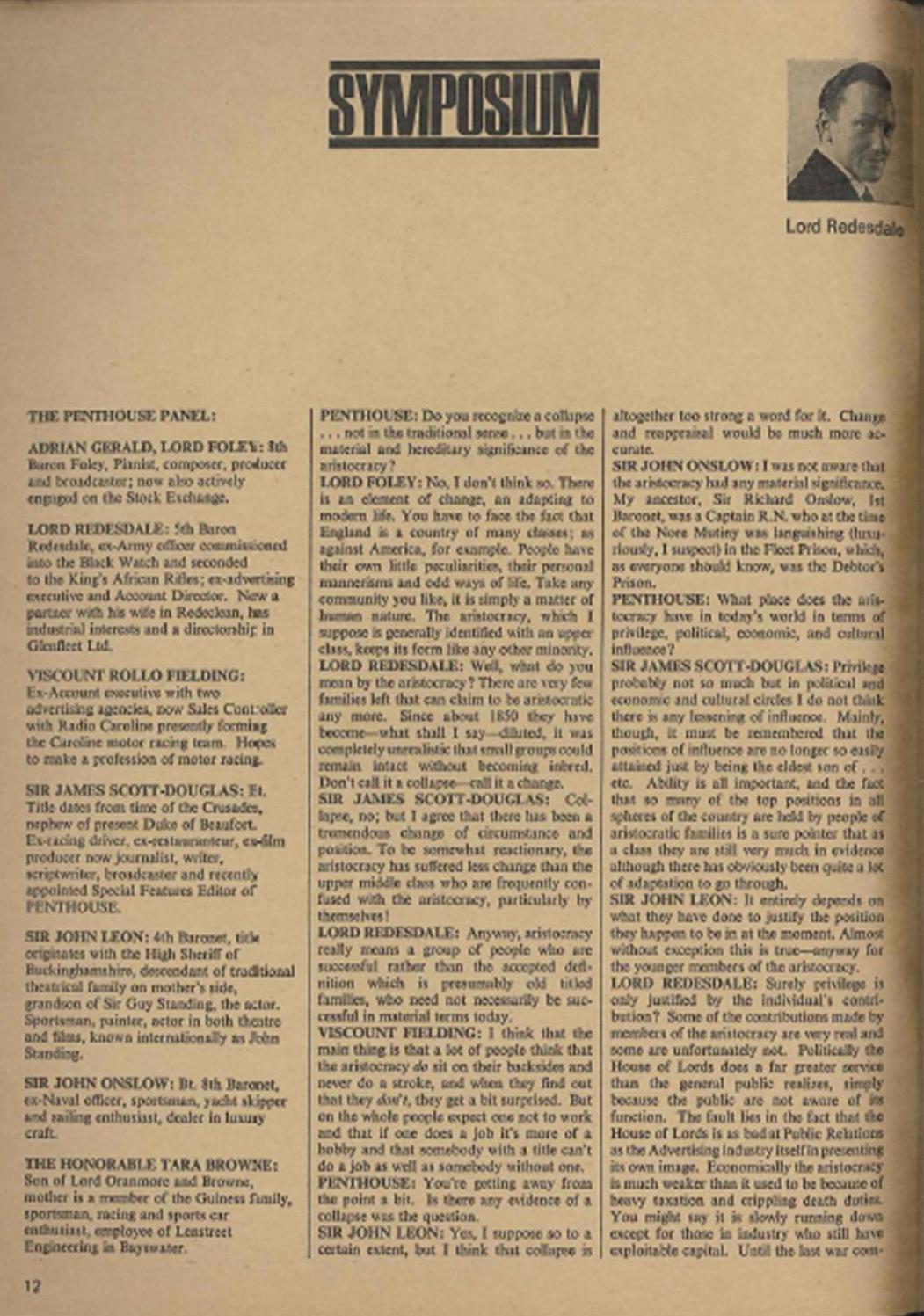
Tara Browne 1965 Penthouse Symposium

I recently dicovered that PID mainstay and 1960s social butterfly, Tara Browne, took part in a symposium about the state of the British aristocracy in a 1965 edition of Penthouse magazine.

Unfortunately, we don't discover a huge amount of new information, however, I am posting what there is.


Tuesday, 14 February 2012

So what do we know about Tara Browne?


Tara Browne and the Rosy Cross


Tara Browne
So what do we know about Tara Browne?

For a man who lived for just 21 short years he seems to have crammed in a great deal of living and had an impact upon a great deal of lives.

By the time of his death on December 18, 1966 he was married to Noreen McSherry the daughter of a County Down farmer. The couple had two children, aged three and one, and were already estranged in what was then a very public battle for custody in the High Courts. Browne was born on 4 March 1945, to Dominick Browne, 4th Baron Oranmore and Browne, a member of the House of Lords since 1927 who later became famous for having served in that house longer than any other peer, finally being evicted during government reforms in 1999; and Oonagh Guinness, heiress to the Guinness fortune and the youngest of the three "Golden Guinness Girls".

Tara's groovy C.V.

It has been widely reported that Tara was educated at Eton, but this is not the case, he was, however, due to inherit around £1 million on his 25th birthday. Even at the age of 21, he left £56,069 in his estate, a sum which would have made him a millionaire today. His inquest described him as a man of "independent means". 


Despite this wealth he worked. According to a 1965 symposium in Penthouse magazine to which he contributed he was employed at Len Street Engineering, a Lotus dealership in Bayswater, presumably where he obtained the ill-fated Lotus Elan which would take his life?

Len Street Engineering where Tara worked
The Lotus Elan in which Tara died?


He also co-owned Dandie fashions on the Kings Road in London. After his death Tara’s share was bought by the Australian, John Crittle, who would transform it with the Beatles into Apple tailoring. Indeed, on the night of his death Tara was on his way to discuss designs for the shop front with graphic artist David Vaughn of Binder, Edwards and Vaughan who also painted a piano for Paul McCartney that he still uses on stage.

Dandie fashions

His 21st birthday party was a lavish affair and he counted Mick Jagger, Keith Richards, Brian Jones, Paul McCartney and his brother Mike, gallery owner Robert Fraser and John Paul Getty among his friends. He was a sufficiently large influence on Keith Richards and John Paul Getty that both would name sons after Tara. 

He was seen with a string of girlfriends including Amanda Lear, who was rumoured to have been born a man, and Suki Potier. Tara was with Amanda Lear in Paris when he introduced her to the artist Salvador Dali and she would go on to be his muse for the rest of his life. I have often wondered if the Paul McCartney painting entitled ‘Tara’s plastic skirt’ is a veiled reference to Amanda Lear and her rumoured sex change operation. 
Tara's Plastic Skirt

Tara's 21st
He was photographed with Suki Potier at his 21st birthday party, alongside Brian Jones, and she would go on to date the Rolling Stones man after Tara’s death and was living with him when he died in 1969. Suki was with Tara at the time of his death and was the passenger in his Lotus. According to her, Browne tried to avoid a car coming straight at him. He swerved to avoid it and crashed into another one trying to save her. Potier claimed Browne was not going particularly fast when he drove down Earls Court Road into Redcliffe Gardens, but independent witnesses at the inquest suggested otherwise and their testimony would appear to be borne out by pictures of the crumpled bonnet and torn-off roof of the sports car. 

He blew his mind out in a car
He didn't notice that the lights had changed

Little has been made about the occupant of the ‘other car’ but I wonder if it may have been a certain Paul McCartney? Suki escaped unhurt but would go on to be killed in a car crash in 1981 with her then husband Robert Ho. It is rumoured she forced the car to swerve over a ravine after her husband asked her for a divorce.

Tara is known to have experimented with LSD and it has been claimed that he and McCartney had been taking it on the night of his death. Tara was also with Paul McCartney one night around Christmas 1965 when the Beatle was involved in a motorcycle accident and chipped a tooth.

Paul after his motorcycle tumble

The Browne family home is Luggala, Co. Wicklow, Ireland. In 1937, Ernest Guinness bought Luggala and gave it as a wedding gift to his daughter, Oonagh, on her marriage to Lord Oranmore and Browne. Oonagh was famous for her 'raffish weekend' parties at Luggala. Guests were driven around at breakneck speed in the Rolls Royce, one guest saying it was like 'being driven from Sodom to Gomorrah'! It became a haven for the intelligentsia of Dublin as well as artists and musicians from around the world.

Tara Browne's Rosicrucian Headstone

As mentioned previously, Tara came from a distinguished family and his father served in the House of Lords. The gravestones of both Tara and his father are extremely interesting for the symbolism displayed. Both feature the family crest – a double headed eagle – whilst his father’s features a griffin above the eagle. The double headed eagle is the emblem of the thirty second and thirty-third (and highest) degrees of Scottish Rite Freemasonry. 

The Browne family crest

Definition: Double-headed Eagle: A Masonic seal and initiation symbol. The eagle is a universal symbol representing the sun, power, authority, victory, the sky gods and the royal head of a nation. 

Alternatively, according to Manley P. Hall, 33rd Degree Freemason, what is being depicted in this symbol is actually a double headed phoenix, not an eagle, he says:
“Among the ancients a fabulous bird called the Phoenix is described by early writers ... in size and shape it resembles the eagle, but with certain differences. The body of the Phoenix is one covered with glossy purple feathers, and the plumes in its tail are alternately blue and red. The head of the bird is light in colour, and about its neck is a circlet of golden plumage. At the back of its back the Phoenix has a crest of feathers of brilliant colour. The Phoenix, it is said, lives for 500 years, and at its death its body opens and the new born Phoenix emerges. Because of this symbolism, the Phoenix is generally regarded as representing immortality and resurrection ... The Phoenix is one sign of the secret orders of the ancient world and of the initiate of those orders, for it was common to refer to one who had been accepted into the temples as a man twice-born, or reborn. Wisdom confers a new life, and those who become wise are born again.”

A phoenix is a mythical bird and has long been presented as a symbol of rebirth, immortality, and renewal.
In my research into the family history of the Oranmore and Browne’s I have discovered a possible family link to a Sir Thomas Browne. Sir Thomas was the son of Sir Valentine Browne and his wife, Thomasine. Thomasine was the sister of Sir Nicholas Bacon, Lord-Keeper of England and loyal servant of Queen Elizabeth I. Sir Nicholas is also the ‘father’ of Sir Francis Bacon. As I have hinted at in my YouTube movies, Sir Francis Bacon is the rumoured illegitimate son of Queen Elizabeth herself and a possible author the works of Shakespeare. Bacon is also believed to have been a leading Rosicrucian and possibly faked his own death. Certainly the works of Bacon and his ‘new science’ influenced the founders of the Royal Society (forerunner of modern freemasonry whose members included Christopher Wren and Issac Newton) which was founded in November 1660, after it was granted a Royal Charter by King Charles II, who it just so happens, is an ancestor of Tara Browne.

I have suggested that the funeral scene depicted on the sleeve of the Sgt Pepper album is a funeral for a friend, and that friend is Tara Browne. After all, he died whilst the album was being produced, his death had a profound effect on Paul McCartney, John Lennon wrote about his death in ‘A Day in the Life’ and the whole cover image was overseen by Tara’s friend Robert Fraser. I have also argued that there is a lot of masonic symbolism depicted on the cover. There are eleven freemasons amongst the cast of ‘people we admire’, and three of these are 33° masons, Karl Marx, H.G. Wells and Aleister Crowley. Indeed if you place a compass over the record cover, Karl Marx and H. G. Wells are placed at exactly 33°. There are the twin temple pillars of Boaz and Jachin as depicted by Sonny Liston (Sun) and Diana Dors (Moon). There are the three appearances of Shirley Temple, one of which features a blood stained model car placed on her lap, possibly a direct reference to Tara’s accident, and the inclusion of the masonic figure of the Legionnaire of the Royal Order of Buffaloes.
Queen Elizabeth I Sgt Pepper style

Furthermore, hidden in the final shot by the Beatles themselves, is an image of Bette Davis dressed as Queen Elizabeth I from the film ‘The Private Lives of Elizabeth and Essex’. 

Could this be a reference to a line of descent from the Queen to Tara Browne?

Update: The hidden truth revealed - read the Sgt Pepper Code


What is the Sgt Pepper Code? Did the Beatles have access to hidden knowledge about the origins of Christianity? Were they taught the secrets of the Freemasons? Had they discovered the history of the Knights Templars or the occult connections of the Illuminati to whom they became exposed? Does the inclusion of Aleister Crowley on the record sleeve reveal their satanic black magic – or black magick -  roots?